

Demystifying the Liminal Space
Or: no, that is not a liminal space–but that’s not to say that it isn’t interesting
This post started as a snarky opinion piece about the overwhelming use and misuse of the term “Liminal Space” online, particularly in regard to aesthetics, but now I think it might be an earnest attempt to put language to the increasingly different definitions of liminality in contemporary non-architectural discourse. In a way I suppose it’s also an earnest attempt to reintroduce concrete spatial liminality to the conversation, but I’ve become curious about the spectrum of visual imagery that falls, for one reason or another, under the umbrella.
In the traditional sense, when we talk about a liminal space, we are talking about spaces that facilitate a transition from one place to another. These are your hallways, doorways, and staircases–on a larger scale, your streets, parking lots and (oftentimes) sidewalks. Among others. I’m hazarding my own definition here, but this facilitation of transition must be a space’s sole purpose in order for it to remain liminal, hence the parentheses about sidewalks. The sidewalk between my office and the Rafferty’s down the street is liminal, but the sidewalk outside of my favorite cafe in Barcelona is not, thanks to its heavily trafficked seating area. The traditional liminal space is not a space to be, it’s the in-between place that allows you to get there.
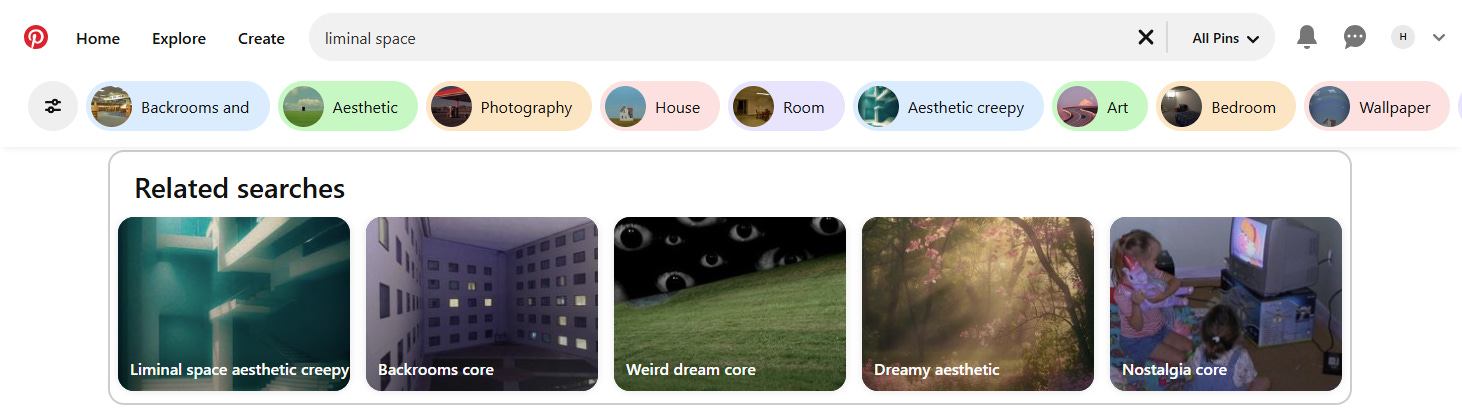
There seems to be a lot of question marks surrounding what defines a liminal space in the viral aesthetic sense. If, in your travels across the internet, you’ve encountered the weirdcore, nostalgiacore, dreamcore (I know, I know, core, core, core, don’t get me started right now), or similar, the odds are high that a #liminalspace hashtag wasn’t far away. But it can be hard to identify what unifies these images, besides the general lack of human bodies in the space depicted. The entry for Liminal Space on the Aesthetics Wiki makes note of this diversion from the traditional meaning: “While this definition is the closest to the usual, academic meaning of liminality, it should be noted that liminal space aesthetics evolved to include places devoid of human presence that are simply nostalgic, dreamlike or uncanny.”
So, okay, this may seem very Old Man Yells At Cloud of me, but it’s the truth. Much of the imagery that the liminal space aesthetic is built upon does not actually feature liminal spaces, at least in the traditional sense. What’s the unifier, then? Immediately identifiable are the invoked senses of emptiness and disuse–these places are often (but not always) dark, and/or sparsely lit by artificial light. There’s an uncanniness to them. But if we think more expansively, I think we could make a direct case for liminality here that goes deeper than “just vibes”. Let’s try. Going off a search for liminal space on Pinterest, here are the broad categories I’m seeing.

Liminal Space Proper


Ahh, yes, the house that Backrooms built: the hallway. Listen, I get the appeal here. There’s always going to be something unsettling about a long, empty hallway. As far as aesthetics go, this category tends to shoot pretty straight—it should be noted that a hallway doesn’t have to be deserted to be liminal, but if you want that sweet sweet post engagement, it helps.


Apart from the hallway, here are some other examples. Notably, these spaces have the unique quality of purposelessness beyond transition, a presiding sense of waiting. For the most part, nobody is hanging out on a train platform unless they’re waiting for a train. Nobody is hanging out on an escalator unless they’re waiting to reach the next floor, to end up somewhere other than where they started. To pull us out of uncanny valley for a moment, here are some equally liminal, yet populated, iterations of these spaces (left to right from FAR, Murray Legge Architecture and Architecture Research Office):


Liminal States


I have a feeling that this could be the actual unifying definition of a Liminal Space as it’s often depicted in the aesthetic sense—structures that are themselves in a state of transition, rather than facilitators of a spatial transition of the user. This leaves room for buildings photographed after-hours, or in states of abandonment. Notably, many images are just normal spaces At Night. This reading seems to assert that a space becomes liminal when it is between uses. By association, could sleep be considered a liminal space? Or is it different because human sleep serves a function, while a building’s closing hours are simply a result of the human need for sleep?


So, no, not actually a liminal space, but I appreciate the abstraction of the premise. The swimming pool, school and grocery store are popular subjects for this category, and if you’re noticing a theme there (suburbia? youth?), stick around.
The Nostalgic


A significant chunk of the images summoned by a Pinterest search for Liminal Space features spaces reminiscent of some universal childhood. Think elementary schools, indoor play areas, swimming pools with slides, single-family home interiors from the nineties and early aughts. Many of these are dark and deserted, meaning they also fall into the previous category, but the childhood scenes give them a certain unsettling patina not present in the others.
I’ve touched on the contemporary addiction to nostalgia before, and this particular strain has Gen Z all over it. If the live-action Disney remake is the late-stage capitalist hallmark of Millennial nostalgia, then pastel renderings of pre-2008 suburban neighborhoods and Y2K product labels on Amazon are the Gen Z analog. These things are obviously only reflective of a certain type of childhood, but they fetishize the middle class suburban landscape in a Tim Burton-esque way.


This is where we begin to see some real overlap into the world of dreamcore (and I could see an argument for the dream as a liminal space, but we won’t get into that now), exacerbated by the use of analog aesthetics and the resultant lack of total clarity. I’m not the first or even the hundredth person to suggest that Gen Z’s nostalgia fetish might be largely escapist: a fixation on a simpler time, back before… well, you know. Everything. But beyond the after-hours vibe going on in these images, I was initially hesitant to grant them any sort of liminality. It’s a playground, for god’s sake! People play there!
After thinking about it more, though, I started to wonder: do the images themselves feel liminal because they create a dichotomy between remembered youth and current existence? Because they emphasize that vastness between? Perhaps the distance between a body and a memory is a liminal space, unique from body to body, from memory to memory. The space depicted might not be a liminal one, but the image itself might hold the power to bring us to an intangible liminal place or state, and keep us there.
So now that we’ve thought about space and liminality in a whole plethora of ways, where does it leave us? I’ve taken a stab at my initial mission—to redignify the liminal space as an architectural component. Perhaps this is rooted in the fear that if we dilute the term liminal space too much, we risk not giving it the attention it deserves in public and private spaces. Liminal spaces aren’t inherently negative, but they can be forgotten about, left relatively untouched since they’re “just hallways”. In fact, it might be the job of the mindful designer (or planner, or developer, or average citizen) to minimize the liminal, beyond absolute necessity, by activating the space (like the case of the Barcelona cafe).
I also wonder if a shared awareness of the different types of liminality, in a more conceptual sense, might lead to a deeper understanding of how our bodies feel in spaces in general. It’s always worthwhile to get more specific, if possible. If we can identify the unsettling quality of an image or space as uncanny, or nostalgic, or surreal, rather than just blanketing it all as liminal, how might that inform our understanding of other parts of the physical world? Maybe not much—maybe it all comes down to vocabulary, an expanded visual dictionary. But I want to talk about art and design and space specifically, and that starts with understanding.
Thanks for tuning in. Go loiter in a liminal space for awhile this weekend—see what it does for you.
That fake grocery store was actually u/Rhettledge on Reddit.